



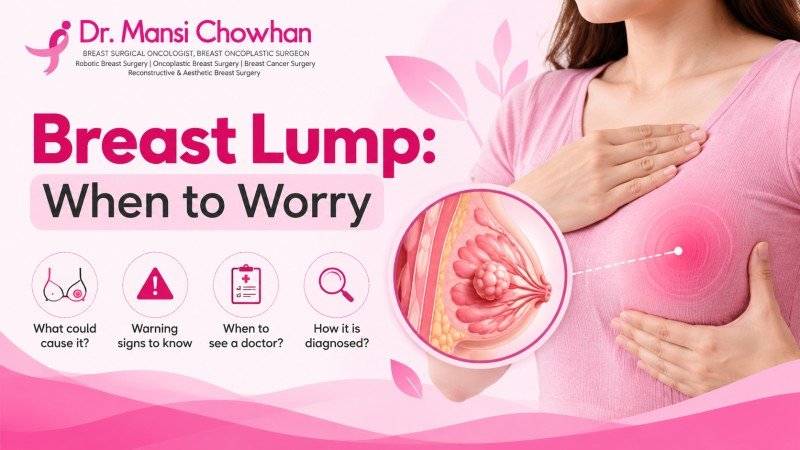
A breast lump is a localized swelling, growth, or thickened area of tissue that feels different from the rest of your breast.
When Should You Worry About a Breast Lump?
A lump that was not there before deserves attention. It may turn out to be a cyst or another harmless growth, but there is no reliable way to know this by touching it.
Pay attention to changes such as:
- A new lump in the breast or underarm.
- A lump that seems to be growing.
- A hard lump that does not move easily under the skin.
- A change in the shape or size of one breast.
- Skin that looks puckered, dimpled or thicker than usual.
- A nipple that has recently started turning inward.
- Blood-stained nipple discharge or fluid leaking without squeezing.
You do not need to have all these symptoms. Sometimes, a lump is the only change a woman notices. In other cases, the breast may look different even when no clear lump can be felt.
These signs do not automatically mean cancer. They are reasons to get the breast examined instead of guessing what might be wrong.
What Does a Breast Lump That Needs Attention Feel Like?
Cancerous lumps may differ from person to person. Some lumps are hard and irregular, while others are smooth and movable beneath the skin.
Hardness of a lump, immobility of a lump, and adherence of a lump to the adjacent tissues are some symptoms of cancerous lumps, and these lumps need to be diagnosed by a doctor. Nevertheless, touch alone is not sufficient for determining whether a lump is cancerous. There are non-cancerous lumps that are hard as well.
Should You Worry About a Painless Breast Lump?
The breast lump does not necessarily have to be painful for it to be of concern. Some breast cancer patients do not experience any form of pain at all. The discovery of such a lump can occur when taking a bath, while dressing up, or when feeling the breasts.
Not all painful lumps are cancerous. Other factors that can cause the pain and swelling are cysts, hormonal changes, or infections.
If you have discovered a lump on your breast, it is better to see a doctor about it even if it is not painful. You should observe any changes in the lump or the area surrounding it. But the best way to identify the nature of the lump is to see a doctor.
What Can Cause a Breast Lump?
Not every breast lump is cancer. Several common conditions can cause a lump or make part of the breast feel thicker than usual.
Fibroadenoma
Fibroadenoma refers to a benign tumor consisting of breast and connective tissues. It occurs more often in young women, and the lump can be hard and round, sliding easily under the skin.
There are those fibroadenomas that remain unchanged over several years, while others continue to grow. This depends largely on the hormonal changes taking place within the body. The doctor may recommend a follow-up examination or biopsy depending on the results of the tests done.
Breast Cyst
A breast cyst arises due to the accumulation of fluid in a sac in the breast area. It may be described as being tender, especially during the days preceding a woman’s menstrual period.
To determine whether the lump in the breast is a cyst, an ultrasound examination may be recommended by the doctor. In most cases, a simple cyst does not need any treatment, but in the event of pain, more examinations are advised.
Hormonal Changes
The breast tissue tends to change in nature during the entire menstrual cycle. Tenderness, swelling, and lumps may develop just before the menses. They could be felt until the start or end of menses.
But what differs from general tenderness of the breast is the development of a definite lump at a certain point within the breast. If you have discovered a new lump, do not just dismiss it as hormonal. Have it evaluated.
Breast Infection
A breast infection could cause breast inflammation and pain. It causes the infected part of the breast to become hot, red, and painful to the touch. Other symptoms include a fever and feeling ill.
Such infections occur frequently among women who breastfeed their children, although some non-breastfeeding women experience them as well. In addition, it is common for a collection of pus in the breasts to form what is called an abscess. In this case, the use of antibiotics alone will not work, and a drainage procedure may be required.
It is very important to seek medical attention when your breast is inflamed, red, and painful.
Which Breast Changes Should You Never Ignore?
A breast lump is not the only sign that something may be wrong. Sometimes, the first change appears in the skin or nipple.
Watch for these symptoms:
- Skin dimpling: The skin develops dents or looks pulled inward.
- Nipple changes: A nipple that recently turns inward or develops a persistent rash.
- Unusual discharge: Blood or fluid comes from the nipple without pressure or squeezing.
- Skin thickening: The breast becomes swollen or develops an orange-peel-like texture.
- A change in breast size: One breast becomes noticeably larger or swollen without an obvious reason.
- A lump in the armpit: A new swelling appears under the arm or near the collarbone.
This is not necessarily a sign of cancer, but it should be taken seriously, especially when the changes persist.
There exists a rare breast cancer referred to as inflammatory breast cancer, which may cause reddening, swelling, and thickened skin on the breast. It does not necessarily have a clear lump. The symptoms are often mistaken for those of breast infection. If treatment of infection fails to provide expected results, a second opinion is needed.
If the breast turns out to be red, warm, and swollen, accompanied by fever and pain, see a doctor immediately. Also, fast skin changes without any clear explanation should be looked at immediately.
How Do Doctors Find Out What a Breast Lump Is?
The doctor is likely to start with an examination of the breasts and ask some questions like when the lump started, whether the size of the lump has changed, whether there is pain and if there is any discharge. If there is a family history of breast cancer.
Clinical Breast Examination
The physician examines both breasts and the area around the armpits. The shape, location, size, and texture of the lump, as well as any changes in the skin or nipple, will be noted.
This is an important examination; however, just because there is a lump does not necessarily mean that it is cancerous.
Breast Ultrasound
Ultrasound makes use of sound waves to create an image of the breasts. This enables doctors to find out whether the lump is a fluid-filled one or a solid one.
Ultrasound is usually the initial imaging test conducted on women below 30 years of age when they develop a new breast lump.
Diagnostic Mammography
Diagnostic mammograms are X-ray exams of the breasts using low doses of radiation for detailed observation. Changes that are hard to see during physical exams become visible through a diagnostic mammogram.
For women over 40 years with a new growth in the breast, diagnostic mammography or digital breast tomosynthesis is recommended. An ultrasound could be included based on the results.
For women between 30 and 39 years, diagnostic mammography and ultrasound are both recommended. This will depend on symptoms and physical exams.
The above recommendations are general. In case of a particular clinical indication, a different recommendation can be made by a doctor.
Breast Biopsy
Often, a biopsy is necessary to determine whether cancerous cells are there or not. Not all lumps require a biopsy, and most of the time a biopsy confirms the benign nature of the lump.
One thing is definitely worth remembering: the normal result of an imaging study does not necessarily conclude the diagnostic procedure.
Should You Wait for a Breast Lump to Go Away?
Many Breast lumps may disappear by themselves, particularly those associated with menstrual cycles. Other lumps may remain unchanged for years without posing any problems. However, when a new lump appears, it needs to be diagnosed by a doctor.
There is no need to wait for several weeks for it to disappear by itself. You need to pay attention to when it first appeared and any changes in your breast. Be careful about squeezing this lump; otherwise, it will become inflamed.
If the doctor recommends that you have a scan, take a biopsy, or undergo another examination, you have to do that even if the lump has shrunk.
Does Age or Family History Affect the Risk?
Both can affect the evaluation of a breast lump.
Benign tumors like fibroadenomas are more common among young women. The risk of developing breast cancer rises with age, although young women may develop it. The presence of a lump should never be ignored just because someone is in their twenties or thirties.
The existence of a family history of the same problem also affects the diagnosis. The risk of developing breast cancer is higher in those with a family history, especially if it involves young women. A strong family history involving breast or ovarian cancer can mean that further evaluation is necessary.
However, there are women with breast cancer who do not have a family history of the illness. The absence of affected relatives is not enough proof of the absence of the illness.
Pregnancy and nursing can result in a lumpier breast texture. Blockage of milk ducts, cysts, and infection are some of the reasons for lumps. A growing or changing lump still requires an examination.
Myth vs Reality: What Should You Know About Breast Lumps?
Myth: A non-painful lump in the breast is nothing to worry about.
Reality: Some cancers do not produce any discomfort at all, particularly during their earlier stages. The presence of a painless lump needs to be investigated if it is new or unexpected.
Myth: A mobile lump on the breast can't possibly be cancerous.
Reality: Most benign lumps can move around, and movement by itself can't determine whether the lump is cancerous or not.
Why Choose Dr. Mansi Chowhan?
Choosing the right specialist is an important step when you discover a breast lump or require further evaluation of a breast condition. Dr. Mansi Chowhan is a surgical oncologist with expertise in breast oncoplastic surgery and breast-related surgical procedures.
As a Breast Oncoplastic Surgeon in Gurgaon, Dr. Mansi Chowhan provides surgical care for selected breast conditions, including procedures for breast lumps and breast cancer. Her website lists services such as breast lump excision, breast conservation surgery, radio-guided breast surgery and breast reconstruction.
When seeking an assessment for a breast lump, patients should have the opportunity to understand their investigation results, discuss appropriate treatment options and ask questions about the benefits and limitations of any recommended procedure.
A specialist consultation can help determine whether a lump requires monitoring, additional diagnostic tests or surgical treatment, based on individual findings.
Related Treatments
- Breast Lump Excision
- Breast Conservation Surgery
- Radio-Guided Breast Surgery
- Therapeutic Mammoplasty
- Modified Radical Mastectomy
- Breast Reconstruction
Conclusion
A lump in the breast may be caused by various factors, and most of these factors are not cancerous. The problem is that one cannot distinguish between them by touch. If you have found any new lump or have noticed changes in your nipples or skin, then you should book an appointment with a doctor.
Dr. Mansi Chowhan is a highly experienced Expert Oncoplastic Breast Surgeon. She specializes in surgical oncology and has more than 15 years of experience. Contacting a specialist will help you find out what is causing your lump and decide on the next steps that you need to take.
Frequently Asked Questions
Is a small lump in the breast cancer?
Yes. Even a small lump may be cancerous, although most small lumps are benign. The size of a lump itself will not be able to say whether or not it is dangerous.
How long should one wait before visiting a doctor due to a breast lump?
One should not purposely wait several weeks or even months before visiting a doctor due to a new lump found. It is necessary to arrange a medical visit immediately.
Are lumps in breasts common among young women?
Yes. Fibroadenomas and cysts are often the reason why young women have lumps in the breast. Yet, breast cancer is possible to happen even at a younger age.
Is a lump in the breast self-resolving?
Lumps that occur as a result of hormonal imbalances may shrink or resolve. However, some lumps may stay as they are. New lumps need evaluation even if their size varies since not all benign lumps shrink or resolve.
Who should you see if you find a lump in your breast?
A breast specialist or a breast surgeon can evaluate the lump and advise you about the required tests. If your breast is red and swollen and at the same time you have a fever and experience much pain, seek medical help.